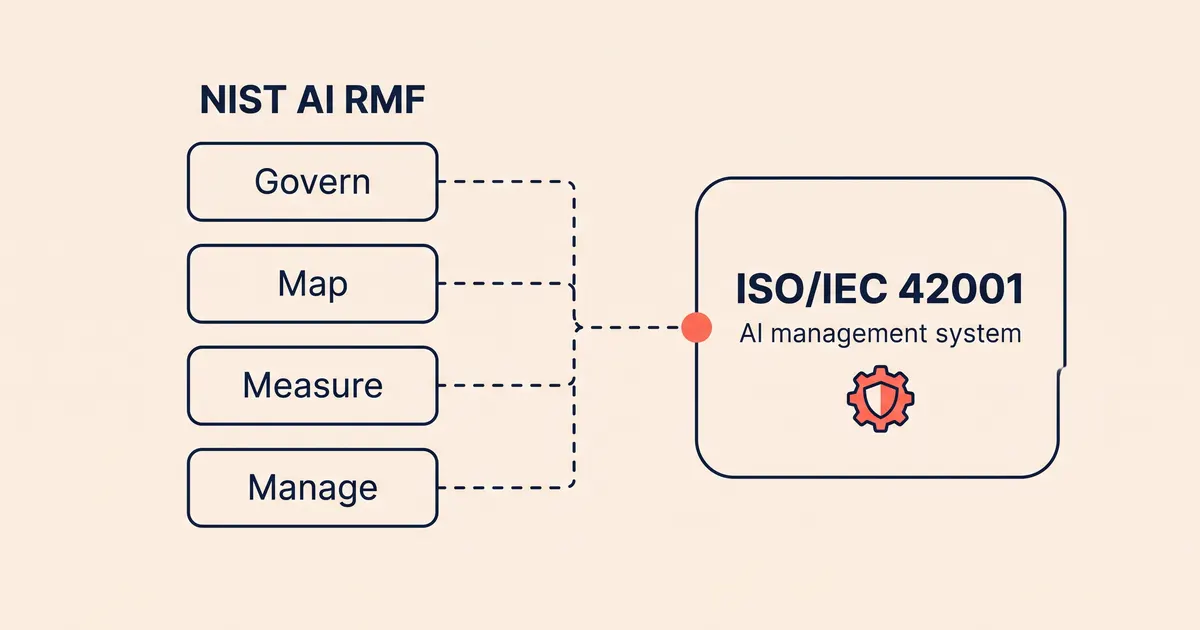
The NIST AI Risk Management Framework is free, voluntary guidance on how to manage AI risk. ISO/IEC 42001 is a paid international standard for an AI management system, and an accredited body can certify you against it. This post maps the two at clause level, lists the evidence that serves both, and explains how each relates to the EU AI Act as of October 2026.
Opsware builds the evaluation pipelines, model inventories, logging and monitoring that both frameworks ask for, as part of its LLMOps and MLOps work.
The mapping comes from NIST's own crosswalk. The ISO text is paywalled, so this post uses only its public table of contents, clause titles and Annex A control titles. It is a practitioner's summary, not legal advice.
The short answer
Use the NIST AI RMF to decide what good AI risk practice looks like for each system. Use ISO/IEC 42001 when you need to prove to customers or auditors that your organization runs those practices on a fixed cycle. Many teams use both: the AI RMF and its Playbook supply the practices, and 42001 supplies the management system and the certificate.
| NIST AI RMF | ISO/IEC 42001 | |
|---|---|---|
| Published | AI RMF 1.0: January 26, 2023 | December 2023 (first edition) |
| Type | Voluntary framework | Management system standard with "shall" requirements |
| Structure | 4 functions, 19 categories, 72 subcategories | Clauses 4 to 10, plus Annex A with 38 controls under 9 control objectives |
| Certification | None. NIST does not certify anyone | Third-party certification by bodies that follow ISO/IEC 42006 |
| Cost of the document | Free | Sold by ISO and national standards bodies |
| Generative AI guidance | NIST AI 600-1 profile (July 2024) | No separate profile. Generative systems fall under the same clauses and controls |
| Status in October 2026 | Under revision. No draft published | First edition in force |
What the NIST AI RMF asks for
NIST AI 100-1 describes itself as "voluntary, rights-preserving, non-sector-specific, and use-case agnostic." Its core has four functions:
- GOVERN (19 subcategories): policies, roles, training, a culture of risk awareness, feedback from outside the team, and third-party risk. It applies across the other three functions.
- MAP (18 subcategories): the context of each system, including its intended purpose, users, benefits, costs, limits and possible impacts.
- MEASURE (22 subcategories): testing, evaluation, verification and validation (TEVV), and tracking risks in production.
- MANAGE (13 subcategories): prioritizing and treating risks, responding to incidents, monitoring after deployment, and decommissioning.
The framework defines seven characteristics of trustworthy AI: valid and reliable; safe; secure and resilient; accountable and transparent; explainable and interpretable; privacy-enhanced; and fair with harmful bias managed. The subcategories are outcomes, such as "Mechanisms are in place to inventory AI systems" (GOVERN 1.6). They are not controls with pass or fail tests.
The AI RMF Playbook suggests actions and documentation for each subcategory. NIST AI 600-1, the Generative AI Profile from July 26, 2024, names 12 risks that generative AI creates or makes worse, including confabulation, data privacy, information security, intellectual property, and value chain and component integration. It lists about 200 suggested actions, each tagged to an AI RMF subcategory.
A current profile records what you do today against the AI RMF, and a target profile records what you want to do. The gap between them is your work plan.
The NIST AI RMF page says that "the AI RMF 1.0 is being revised as part of the White House AI Action Plan." The July 2025 Action Plan asks NIST to remove references to misinformation, diversity, equity and inclusion, and climate change. As of October 30, 2026, NIST has not published a draft, so version 1.0 is still the current text.
What ISO/IEC 42001 asks for
ISO/IEC 42001 follows the same clause layout as ISO/IEC 27001 and ISO 9001. Clauses 4 to 10 hold the requirements that every certified organization must meet:
- Clause 4, context: context, interested parties and the scope of the AI management system.
- Clause 5, leadership: management commitment, the AI policy, and roles.
- Clause 6, planning: AI risk assessment (6.1.2), risk treatment (6.1.3), AI system impact assessment (6.1.4), objectives (6.2) and planning of changes (6.3).
- Clause 7, support: resources, competence, awareness, communication and documented information.
- Clause 8, operation: operational control, and running the assessments and treatment planned in clause 6.
- Clause 9, performance evaluation: monitoring, internal audit and management review.
- Clause 10, improvement: continual improvement and corrective action.
Annex A is normative and lists 38 reference controls under nine control objectives:
| Objective | Topic | Controls |
|---|---|---|
| A.2 | Policies related to AI | 3 |
| A.3 | Internal organization (roles, reporting of concerns) | 2 |
| A.4 | Resources for AI systems (data, tooling, compute, people) | 5 |
| A.5 | Assessing impacts of AI systems | 4 |
| A.6 | AI system life cycle (requirements to deployment, monitoring, documentation and event logs) | 9 |
| A.7 | Data for AI systems (acquisition, quality, provenance, preparation) | 5 |
| A.8 | Information for interested parties (user documentation, external reporting, incidents) | 4 |
| A.9 | Use of AI systems (responsible use, intended use) | 3 |
| A.10 | Third-party and customer relationships | 3 |
Your risk treatment, the plan for handling each assessed risk, decides which controls apply. You record every control, with the reason for including or excluding it, in a statement of applicability. Annex B gives implementation guidance for each control, and its numbering matches Annex A, so B.6.2.6 is the guidance for control A.6.2.6. Annexes C and D are informative. Annex C lists possible AI objectives and risk sources, and Annex D covers use of the standard across sectors.
ISO/IEC 42006:2025, published in July 2025, sets the requirements for bodies that certify AI management systems, on top of ISO/IEC 17021-1. ISO/IEC 42005:2025 gives guidance on the impact assessments that clause 6.1.4 and Annex A.5 require.
How the two map, function by function
NIST published a crosswalk from the AI RMF to ISO/IEC 42001. It links each of the 72 subcategories to one or more clauses and controls. The table below groups the crosswalk by function and adds the evidence an auditor or reviewer would ask to see. The crosswalk cites Annex B numbers, and this table converts them to the matching Annex A numbers.
| AI RMF function | Main 42001 clauses | Main Annex A controls | Evidence that serves both |
|---|---|---|---|
| GOVERN | 4.1 context; 5.1 leadership; 5.2 AI policy; 5.3 roles; 6.1 risk process; 7.1 to 7.4 resources, competence, awareness and communication; 9.3 management review | A.2 policy; A.3.2 roles; A.4.2 to A.4.6 resource documentation (the inventory in GOVERN 1.6); A.10.2 and A.10.3 responsibilities and suppliers (GOVERN 6) | AI policy, role assignments, AI system inventory, training records, supplier risk reviews, management review minutes |
| MAP | 4.1 context; 4.3 scope; 6.1.2 risk assessment; 6.1.4 impact assessment; 6.2 objectives | A.5.2 to A.5.5 impact assessment; A.6.2.2 requirements; A.6.2.3 design documentation; A.7.2 to A.7.6 data (MAP 2.3); A.9.4 intended use | Intended-use statement per system, impact assessments, written risk tolerance, data provenance records, system requirements |
| MEASURE | 6.1.2 risk assessment; 8.2 risk assessment in operation; 9.1 monitoring and measurement; 9.2.2 internal audit | A.6.2.4 verification and validation; A.6.2.6 operation and monitoring; A.6.2.8 event logs; A.7.4 data quality; A.5.4 and A.5.5 for fairness and environmental impact | Evaluation datasets and results, bias tests, red-team reports, production metrics and logs, internal audit reports |
| MANAGE | 6.1.3 risk treatment; 8.3 risk treatment in operation; 9.3.3 review results; 10.1 continual improvement; 10.2 corrective action | A.6.2.5 deployment; A.6.2.6 operation and monitoring; A.8.3 external reporting; A.8.4 incident communication; A.9.4 intended use; A.10.3 suppliers | Risk treatment plan, statement of applicability, incident log, corrective actions, runbook to roll back or switch off a model, change records |
Some subcategories map to only one or two controls. Decommissioning (GOVERN 1.7) maps only to A.6.2.6, and fairness and environmental impact (MEASURE 2.11 and 2.12) map only to the impact assessment controls. For those subcategories, use the Playbook actions and record the results in your 42001 assessments.
What NIST's crosswalk does and does not tell you
Check these limits before you use the crosswalk as an audit map:
- It maps to a draft. Its title says "ISO/IEC FDIS 42001", the final draft, and the PDF file dates from May 2023. ISO published the standard in December 2023. Check each reference against your purchased copy.
- It cites Annex B, not Annex A. Auditors and your statement of applicability use Annex A numbers, so convert each B reference to the matching A number.
- Some cells are wrong. GOVERN 3.2 cites "B.3.2 Management review inputs", but management review inputs is clause 9.3.2 and B.3.2 covers AI roles. MAP 1.4 cites "B.2.2 Customers", but customers is B.10.4. MAP 1.5 cites "6.1.1 Objective", and clause 6.1.1 is titled "General".
- It runs in one direction. It starts from the AI RMF. Clauses 4.2 (interested parties), 6.3 (planning of changes), 7.5.1 and 7.5.2 (documented information) and 8.1 (operational planning and control) never appear. A team that follows only the AI RMF will have no evidence for those clauses.
- A mapping is not conformity. Meeting an AI RMF outcome does not show that the matching 42001 clause is met. The clauses also require the management system cycle around the work: documented scope, internal audit, management review and corrective action.
The last two limits show where the extra work lies in moving from the AI RMF to 42001 certification: the management system around the practices, more than the practices themselves.
Evidence to build once
Both frameworks ask for the same records. Build them once per AI system and keep them in one place:
- AI system inventory. List each system with its owner, intended use, model and version, data sources, third-party components and deployment status. This covers GOVERN 1.6, MAP 4.2 and Annex A.4.
- Impact assessment. Write one assessment per system covering affected people, groups and wider society. It serves MAP 1.1, MAP 3.1 to 3.3, clause 6.1.4 and A.5.
- Risk register and treatment plan. Record likelihood, severity, owner and chosen response for each risk. This covers MAP 5.1, MANAGE 1.2 to 1.3, clauses 6.1.2 and 6.1.3, and the statement of applicability.
- Evaluation records. Keep test sets, metrics, bias tests and red-team results, versioned with the model they tested. These records cover MEASURE 2.1 to 2.13 and A.6.2.4.
- Production monitoring and logs. Keep traces, quality and drift metrics, and alerts with their thresholds. These records cover MEASURE 2.4, MANAGE 4.1, A.6.2.6 and A.6.2.8.
- Incident and change log. Record incidents, rollbacks, model swaps and corrective actions. This covers MANAGE 2.3 and 4.3, A.8.4 and clause 10.2.
Evaluation records and production monitoring come from your engineering stack. Our post on LLM monitoring and observability lists the trace fields and evaluation signals to record, and the same records answer MEASURE and A.6.2.6.
Which one to start with
Start with the NIST AI RMF in these cases:
- No customer or contract asks for a certificate yet.
- You have a few AI systems and want working practices before you build process around them.
- You build generative AI features and want the specific risk list and actions in AI 600-1.
Start with ISO/IEC 42001 in these cases:
- Enterprise customers ask for a certificate in security questionnaires or contracts.
- You already hold ISO/IEC 27001 or ISO 9001, so you can extend your existing internal audit, management review and document control to cover AI.
- You need one governance system across many AI systems and business units.
The two also work in sequence. Run a current-state profile against the AI RMF to find gaps, close them using the Playbook and AI 600-1, and add the 42001 management system when you need certification. If you start with 42001, use the AI RMF subcategories as a checklist to see whether your risk and impact assessments go deep enough.
Where the EU AI Act fits
Neither framework gives you a presumption of conformity with the EU AI Act, which means regulators would accept that you meet the covered requirements unless shown otherwise. Under Article 40, only harmonised standards whose references are published in the Official Journal give that presumption. The AI RMF is a US government framework with no legal status in the EU. ISO/IEC 42001 is an international standard, and the EU has not cited it as a harmonised standard.
The first harmonised standard under the AI Act is now in place. Commission Implementing Decision (EU) 2026/2274, published in the Official Journal on October 14, 2026, cites EN 18286:2026, "Artificial intelligence – Quality management system for EU AI Act regulatory purposes." It covers the quality management system that Article 17 requires from providers of high-risk systems. Risk management (Article 9), data governance (Article 10), human oversight and cybersecurity have no harmonised standard yet. An analysis by the Cloud Security Alliance notes that the draft of EN 18286 included a mapping to ISO/IEC 42001 Annex A, so work done for 42001 can be reused for EN 18286.
After the Digital Omnibus on AI, the AI Act's high-risk rules apply to systems listed in its Annex III, such as hiring and credit scoring, from December 2, 2027. For AI in products listed in its Annex I, such as medical devices, they apply from August 2, 2028. Most LLM features are not high-risk. They still face the Article 50 transparency duties, which have applied since August 2, 2026, and neither framework covers those disclosures directly. Our post on where the EU AI Act and GDPR overlap covers the dates, roles and Article 50 in detail.
An EU provider of a high-risk system can build the AI RMF practices, run them inside a 42001 management system, and then add what EN 18286 and the AI Act require per system, such as technical documentation, conformity assessment and post-market monitoring.
Frequently asked questions
Can you get certified against the NIST AI RMF?
No. The AI RMF is a voluntary framework and NIST does not certify organizations against it. ISO/IEC 42001 is the one of the two with accredited third-party certification.
Does ISO 42001 certification mean compliance with the EU AI Act?
No. ISO/IEC 42001 is not a harmonised standard, so a certificate gives no presumption of conformity under Article 40. The first harmonised standard, EN 18286:2026, covers the Article 17 quality management system and was cited in the Official Journal on October 14, 2026.
How many controls are in ISO 42001 and the NIST AI RMF?
ISO/IEC 42001 Annex A lists 38 controls under nine control objectives, and you choose which apply through risk treatment. The NIST AI RMF has no controls. It has 72 subcategories, which are outcomes grouped into 19 categories under four functions.
Is there a mapping between the NIST AI RMF and ISO 42001?
Yes. NIST publishes a crosswalk that links each AI RMF subcategory to ISO/IEC 42001 clauses and controls. It was built against the 2023 final draft, cites Annex B numbers rather than Annex A, and has a few wrong references, so check it against the published standard.
Should a company start with the NIST AI RMF or ISO 42001?
Start with the AI RMF if no customer asks for a certificate and you want working practices first. Start with ISO/IEC 42001 if customers require certification or you already run ISO 27001 or ISO 9001. Many teams use the AI RMF for practices and 42001 for the management system.
Does the NIST AI RMF cover generative AI?
Yes, through NIST AI 600-1, the Generative AI Profile published on July 26, 2024. It names 12 risks that generative AI creates or makes worse and lists about 200 suggested actions tagged to AI RMF subcategories.
Sources
- NIST: AI RMF 1.0 (NIST AI 100-1); AI RMF Playbook; Generative AI Profile (NIST AI 600-1); AI RMF to ISO/IEC FDIS 42001 crosswalk; AI RMF project page (revision status)
- White House: America's AI Action Plan (July 2025)
- ISO: ISO/IEC 42001:2023; ISO/IEC 42006:2025; ISO/IEC 42005:2025
- EU: AI Act, Regulation (EU) 2024/1689; Regulation (EU) 2026/1744 (Digital Omnibus on AI); Implementing Decision (EU) 2026/2274 (EN 18286:2026); CEN-CENELEC on EN 18286
Need this built?
The guide "LLM privacy: data flows, duties and controls" covers the privacy side of the same systems. We build model inventories, evaluation pipelines, monitoring and incident logging in our LLMOps and MLOps services. To plan the engineering records an AI RMF or ISO/IEC 42001 program needs, request a quote or email [email protected].