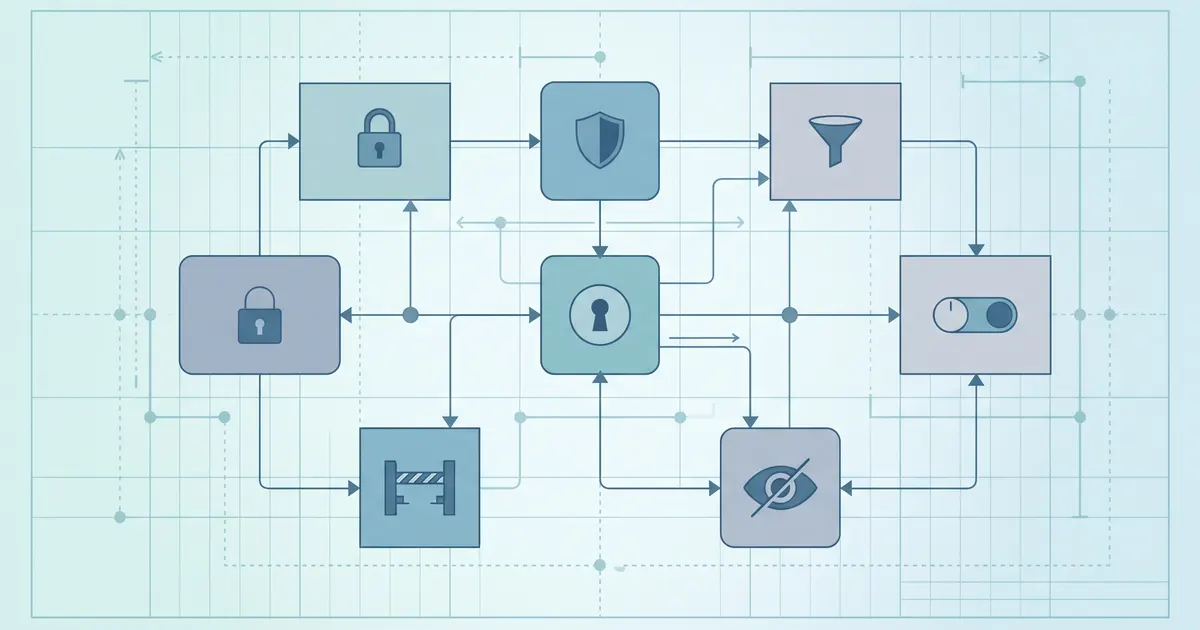
Privacy by design means building privacy into a system while you design it. This page takes each of the seven privacy by design principles and turns it into specific engineering and operations practice for data pipelines, logs, analytics and LLM features. It then maps the principles to GDPR Articles 5 and 25 and ends with a checklist.
Opsware builds data pipelines, deletion jobs, PII redaction and LLM applications with these controls built in, as part of our data science, LLMOps and Python and Node development work.
What privacy by design is
Ann Cavoukian developed privacy by design in the 1990s. As Information and Privacy Commissioner of Ontario, she published it as seven foundational principles. The framework applies to three areas: IT systems, accountable business practices, and networked infrastructure.
In October 2010, the International Conference of Data Protection Authorities and Privacy Commissioners passed a resolution, unanimously, that recognized privacy by design as an essential part of privacy protection. Since then the idea has moved into law and standards:
- GDPR Article 25 requires "data protection by design and by default" from every controller. This is the legal duty in the EU.
- The FTC's March 2012 privacy report made privacy by design one of its core principles: "Companies should promote consumer privacy throughout their organizations and at every stage of the development of their products and services." The FTC listed data security, reasonable collection limits, sound retention and disposal practices, and data accuracy as the protections to build in.
- ISO 31700-1, published in 2023, sets high-level privacy by design requirements for consumer goods and services. A companion report, ISO/TR 31700-2, gives use cases.
The seven principles describe goals. They do not name controls, and GDPR Article 25 does not either. The European Data Protection Board (EDPB) says in its Guidelines 4/2019 on Article 25 that the article "does not require the implementation of any specific technical and organizational measures". The measures you choose have to work for the processing in front of you.
The seven privacy by design principles at a glance
| Principle | What it asks | What it looks like in a system |
|---|---|---|
| 1. Proactive not reactive; preventative not remedial | Find privacy risks before they cause harm | Privacy questions in the design review, a DPIA trigger, schema review for new personal data fields |
| 2. Privacy as the default setting | Data is protected if the person does nothing | Optional fields off, short default retention, least-privilege roles, prompt logging off or redacted |
| 3. Privacy embedded into design | Privacy is part of the architecture, not an add-on | Field-level tags, pseudonymization at ingestion, a deletion path built into every store |
| 4. Full functionality: positive-sum, not zero-sum | Meet business goals and privacy goals together | Analytics on pseudonymous IDs, aggregates, retrieval filtered by the user's permissions |
| 5. End-to-end security: full lifecycle protection | Protect data from collection to destruction | Encryption, access control and logging at each stage, deletion that reaches backups, traces and indexes |
| 6. Visibility and transparency: keep it open | The system does what you say it does, and others can check | A ROPA and privacy notice that match the code, a subprocessor list, automated checks |
| 7. Respect for user privacy: keep it user-centric | Put the individual's interests first | Equal consent choices, self-service access and deletion, a way to correct data |
1. Proactive not reactive
The first principle says privacy by design "comes before-the-fact, not after". It does not wait for a breach or a complaint. In an engineering team, the work happens at the design review and the pull request, before data starts flowing.
- Add privacy questions to the design doc template. What personal data does the feature collect, and for what purpose? Where is it stored? Who can read it? How long is it kept, and how is it deleted?
- Set a DPIA trigger. Write down when a feature needs a data protection impact assessment, such as new special category data, profiling, or a new vendor that receives personal data. The design review checks the trigger.
- Review schema changes for personal data. A new column or event property that holds an email, a location or free text gets a purpose and a retention period before it merges. A CI check can flag new fields whose names or sample values look like personal data.
- Decide LLM logging before launch. Prompts and responses often contain personal data that users typed. Decide what the trace store keeps, whether it is redacted, and for how long, before the first production request. The guide on PII redaction for LLM prompts and traces covers the options.
The EDPB makes the same point about timing. Data protection by design applies "at the time of the determination of the means for processing", and the EDPB says the means include "the architecture, procedures, protocols, layout and appearance". Buying software, hardware or a service also counts as deciding the means.
2. Privacy as the default setting
The second principle says: "If an individual does nothing, their privacy still remains intact." GDPR Article 25(2) turns this into four dimensions. By default, only the personal data needed for each purpose is processed, and that applies to "the amount of personal data collected, the extent of their processing, the period of their storage and their accessibility".
| Article 25(2) dimension | Default setting in practice |
|---|---|
| Amount collected | Forms ask only for required fields. Event tracking sends no free text and no full IP addresses unless a purpose needs them. Request logs omit request bodies. |
| Extent of processing | A dataset collected for billing is not joined into marketing models by default. New uses go through review. |
| Storage period | Every table, bucket, log index and trace store has a TTL or a deletion job from the day it is created. |
| Accessibility | New roles start with no access to personal data. Profiles and shared content are private until the person makes them public. |
The EDPB gives an example of a web shop. Date of birth and phone number cannot be required fields for a prepaid book order, and an eBook order form does not need a delivery address. The same test applies to sign-up forms, onboarding surveys and API payloads.
For LLM features, the defaults that matter most are:
- Prompt and response logging is off, or on with redaction, and the trace store has a short retention period.
- Customer data is not used to train or fine-tune models unless a documented purpose and legal basis exist.
- Model provider accounts use the provider's data retention and training opt-outs where the provider offers them. The guide on zero data retention and DPAs at model providers covers the contract side.
3. Privacy embedded into design
The third principle says privacy measures are "not bolted on as add-ons, after the fact". The longer version of the principles adds that the result should be "not easily degraded through use, misconfiguration or error". For engineers, that means the controls live in the architecture and the code, where a config change cannot quietly switch them off.
- Tag personal data at the field level. Mark columns and event properties with a data category and a sensitivity level in the schema or the data catalog. Masking, access rules and retention can then read the tags. The data classification policy guide covers the levels.
- Pseudonymize at ingestion. Replace direct identifiers with tokens as data enters the warehouse, and keep the mapping in a separate store with its own access control. The EDPB lists this as a minimization measure: pseudonymize "as soon as it is no longer necessary to have directly identifiable personal data, and store identification keys separately".
- Build the deletion path with the store. Each new store needs a way to find and delete one person's records. Add it when you create the store. Adding it later, during the first access or deletion request, takes far more work.
- Write policy as code. Access rules, retention periods and masking rules in version-controlled config can be reviewed and tested like other code. A test that fails when a table has no retention setting stops the gap from reaching production.
- Keep fewer copies. The EDPB asks controllers to limit "temporary" copies and to make data flows "efficient enough to not create more copies than necessary". CSV exports, notebook caches and debug dumps are the usual copies that nobody deletes.
The principle also asks for privacy impact assessments, which the IPC text says should be "carried out and published" where possible. In GDPR terms, that is the DPIA under Article 35 for high-risk processing.
4. Full functionality: positive-sum, not zero-sum
The fourth principle rejects the idea that privacy must cost functionality or security. The IPC text calls "privacy vs. security" a false dichotomy and says it is possible to have both. In practice, many features work as well on less identifying data:
- Product analytics can count users, funnels and retention on pseudonymous IDs. The analytics team rarely needs names or emails.
- Dashboards and reports can use aggregates. The EDPB lists "Use aggregated data when possible" as a minimization measure.
- Retrieval-augmented generation (RAG) can filter retrieved chunks by the user's existing permissions. Each user gets answers from the documents they could already open, and nothing else.
- Audit logs can record who accessed which record and when without copying the record's content into the log. The log then supports security investigations without copying customer records into another store.
Where a real trade-off remains, the principle asks you to document it. The IPC text says "all interests and objectives must be clearly documented, desired functions articulated, metrics agreed upon and applied". The EDPB suggests the same for Article 25. A controller may use key performance indicators (KPIs) to show a measure works, such as the rate of false positives and false negatives or the response time to rights requests.
5. End-to-end security: full lifecycle protection
The fifth principle covers the data's whole life, "cradle to grave". The IPC text names "methods of secure destruction, appropriate encryption, and strong access control and logging methods". The table below follows one record through a typical system.
| Stage | Controls |
|---|---|
| Collection | TLS in transit, input validation, no personal data in URLs or query strings |
| Storage | Encryption at rest, managed keys, separate stores for special category data |
| Use | Role-based access, access segregation, logging of reads on sensitive data |
| Sharing | A DPA with each processor, minimum fields sent, encrypted transfer |
| Copies | Logs, traces, caches, exports and embeddings are listed in the data map and get retention periods |
| Deletion | Scheduled deletion jobs, deletion that reaches backups when they expire, tests that deleted data cannot be recovered |
Access segregation is a design choice as well as a permission setting. The EDPB says processing should be shaped so that "no individual needs comprehensive access to all data collected about a data subject". A support agent who needs order history does not need the full profile, payment data and support transcripts in one view.
LLM systems add copies that teams often miss: prompt traces, evaluation datasets built from production traffic, and vector stores that hold chunk text next to the embeddings. Each one needs a retention period and a deletion path. The guide on access and deletion requests against LLM logs and vector stores covers how to reach them. The GDPR Article 32 security controls guide covers encryption, access control, logging and backups in more detail.
6. Visibility and transparency
The sixth principle asks that a system operates "according to the stated promises and objectives, subject to independent verification". The IPC text sums it up as "trust but verify". For an engineering team, the gap to close is between what the documents say and what the code does.
- Keep the records of processing current. The record of processing activities (ROPA) and the data map should list each system, data category, purpose, recipient and retention period.
- Check the documents against the systems. A scheduled job can compare the schemas in the warehouse with the data map and flag tables or columns that the map does not list.
- Publish the vendor list. A subprocessor list tells customers where their data goes, and change notices tell them when that changes.
- Make the privacy notice match the system. If the notice says logs are kept for 30 days, a test or monitor should confirm the log retention setting is 30 days.
- Name an owner. The principle maps to the fair information practice of accountability, which asks that responsibility for privacy policies be "assigned to a specified individual".
GDPR Article 5(2) sets the legal version of this principle: the controller "shall be responsible for, and be able to demonstrate compliance with" the Article 5 principles. Documentation and test results are how you demonstrate it.
7. Respect for user privacy
The seventh principle asks architects and operators to offer "strong privacy defaults, appropriate notice, and empowering user-friendly options". It draws on four fair information practices: consent, accuracy, access and compliance.
- Present consent choices equally. The EDPB calls interfaces that nudge people toward sharing more data "dark patterns" and says they are "contrary to the spirit of Article 25". Its example presents consent and refusal as "two equally visible choices".
- Let people see and export their data. A self-service export or a fast access request process meets the access practice. The DSAR automation guide covers the request workflow.
- Let people correct their data. Editable profile fields and a correction path for data the person cannot edit meet the accuracy practice.
- Make withdrawal as easy as consent. A setting that turns off optional processing should stop it in every system that reads the flag, including downstream pipelines.
- Give a way to complain. A contact point for privacy questions, with a reply process, meets the compliance practice.
How the principles map to GDPR Articles 5 and 25
GDPR Article 25(1) requires controllers to implement "appropriate technical and organisational measures, such as pseudonymisation, which are designed to implement data-protection principles, such as data minimisation, in an effective manner". The data protection principles it refers to are in Article 5. The table maps each Article 5 principle to the privacy by design principle closest to it and to a measure from this page.
| GDPR Article 5 principle | Closest privacy by design principle | Example measure |
|---|---|---|
| 5(1)(a) Lawfulness, fairness and transparency | 6 Visibility and transparency; 7 Respect for user privacy | Notice that matches the system, equal consent choices |
| 5(1)(b) Purpose limitation | 2 Privacy as the default | Purpose recorded per field, review before new uses |
| 5(1)(c) Data minimisation | 2 Privacy as the default; 4 Full functionality | Required fields only, pseudonymous analytics, aggregates |
| 5(1)(d) Accuracy | 7 Respect for user privacy | Editable profiles, correction requests |
| 5(1)(e) Storage limitation | 2 Privacy as the default; 5 End-to-end security | TTLs on every store, deletion jobs, retention for logs and traces |
| 5(1)(f) Integrity and confidentiality | 5 End-to-end security | Encryption, access segregation, read logging |
| 5(2) Accountability | 6 Visibility and transparency; 1 Proactive | Design review records, DPIAs, checks that compare documents with systems |
Four points from Article 25 and the EDPB guidelines matter for engineering teams:
- Two moments. Article 25(1) applies "both at the time of the determination of the means for processing and at the time of the processing itself". A control that worked at launch has to keep working, and the EDPB says controllers must review the effectiveness of their measures over time.
- Legacy systems. The EDPB says systems built before the GDPR are under the same obligations. A legacy system that does not comply and cannot be changed to comply "cannot be used to process personal data".
- Vendors. The EDPB says controllers "should not choose producers or processors who do not offer systems enabling or supporting the controller to comply with Article 25". Ask vendors how their product supports deletion, access control and retention before you buy.
- Fines. Under Article 83(4), infringing Article 25 can lead to a fine of up to 10 million euros or 2% of total worldwide annual turnover, whichever is higher. Under Article 83(2)(d), the measures a company took under Articles 25 and 32 count when a regulator sets a fine for any infringement.
Article 25(3) adds that an approved certification under Article 42 may be used as one element to demonstrate compliance. The EDPB also says that privacy-enhancing technologies "in themselves do not necessarily cover the obligations of Article 25". Buying a tool does not meet the duty. The tool has to implement the principles for your processing.
Privacy by design checklist
Use this list in design reviews and before launch. Each item points back to a principle above.
Design
- The design doc lists each personal data field, its purpose, where it is stored, who can read it and how long it is kept. (1, 3)
- The DPIA trigger was checked, and a DPIA exists if the trigger applies. (1)
- Each new vendor that receives personal data has a DPA and is on the subprocessor list. (5, 6)
- Trade-offs between privacy and other goals are written down with the metric used to judge them. (4)
Defaults
- Forms and APIs require only the fields the purpose needs. (2)
- New roles start with no access to personal data. (2)
- Optional processing, such as marketing tracking, is off until the person turns it on. (2, 7)
- LLM prompt logging is off or redacted, and customer data is not used for training without a documented purpose and legal basis. (2)
Build
- Personal data fields carry a category and sensitivity tag. (3)
- Direct identifiers are pseudonymized at ingestion, and the mapping is stored separately. (3)
- Every store, including logs, traces, caches and vector indexes, has a retention setting and a deletion path for one person's records. (3, 5)
- Access, retention and masking rules are in version control and covered by tests. (3)
- Consent and refusal are equally visible, and withdrawal is as easy as consent. (7)
Operate
- A scheduled check compares warehouse schemas with the data map. (6)
- Deletion jobs are monitored, and deleted data has been tested as unrecoverable. (5)
- The privacy notice's retention periods match the system settings. (6)
- Access and deletion requests are completed within the legal deadline, and response times are tracked. (7)
- Measures are reviewed when the processing, the risk or the available technology changes. (1)
Limits of the framework
The seven principles are broad. They say what a system should achieve, not which control to build, so two teams can both claim to follow them and build very different systems. GDPR Article 25 has the same shape, and the EDPB fills part of the gap with lists of "key design and default elements" for each Article 5 principle. Those lists are examples. The EDPB calls them "neither exhaustive nor binding".
Write down which measure you chose for each principle and why, and test that it works. That record is also what a regulator or a customer's security review will ask to see.
Frequently asked questions
What are the 7 principles of privacy by design?
They are: proactive not reactive; privacy as the default setting; privacy embedded into design; full functionality (positive-sum, not zero-sum); end-to-end security across the data lifecycle; visibility and transparency; and respect for user privacy.
Who created privacy by design?
Ann Cavoukian, a former Information and Privacy Commissioner of Ontario, developed privacy by design in the 1990s. In October 2010, the International Conference of Data Protection Authorities and Privacy Commissioners passed a unanimous resolution recognizing it.
Is privacy by design required by GDPR?
Yes. GDPR Article 25 requires controllers to implement data protection by design and by default. Infringing Article 25 can lead to a fine of up to 10 million euros or 2% of total worldwide annual turnover, whichever is higher.
What is the difference between privacy by design and privacy by default?
Privacy by design means building privacy measures into a system while you design and run it. Privacy by default means that, without any action by the person, only the personal data needed for each purpose is processed. GDPR Article 25(2) applies that to the amount of data collected, the extent of processing, the storage period and accessibility.
What is an example of privacy by design?
The EDPB gives a web shop example: a prepaid book order form does not require date of birth or phone number, and an eBook order form does not ask for a delivery address. In an engineering system, pseudonymizing identifiers at ingestion and giving every store a retention period are common examples.
What is ISO 31700?
ISO 31700-1, published in 2023, sets high-level privacy by design requirements for consumer goods and services. A companion report, ISO/TR 31700-2, gives use cases.
Sources
- Information and Privacy Commissioner of Ontario: Privacy by Design: The 7 Foundational Principles (copy hosted by The Sedona Conference) and Implementation and Mapping of Fair Information Practices (copy hosted by the University of Waterloo)
- GDPR: Regulation (EU) 2016/679, Articles 5, 25 and 83
- EDPB: Guidelines 4/2019 on Article 25 Data Protection by Design and by Default, version 2.0, adopted 20 October 2020
- FTC: Protecting Consumer Privacy in an Era of Rapid Change: Recommendations for Businesses and Policymakers, March 2012
- ISO: ISO 31700-1:2023, Consumer protection: Privacy by design for consumer goods and services, Part 1: High-level requirements
Need this built?
We build pseudonymization at ingestion, retention and deletion jobs, PII redaction for LLM traces, and checks that compare your data map with your systems, as part of our data science, LLMOps and Python and Node development work. Tell us about your project, and we will reply with questions or a rough plan.